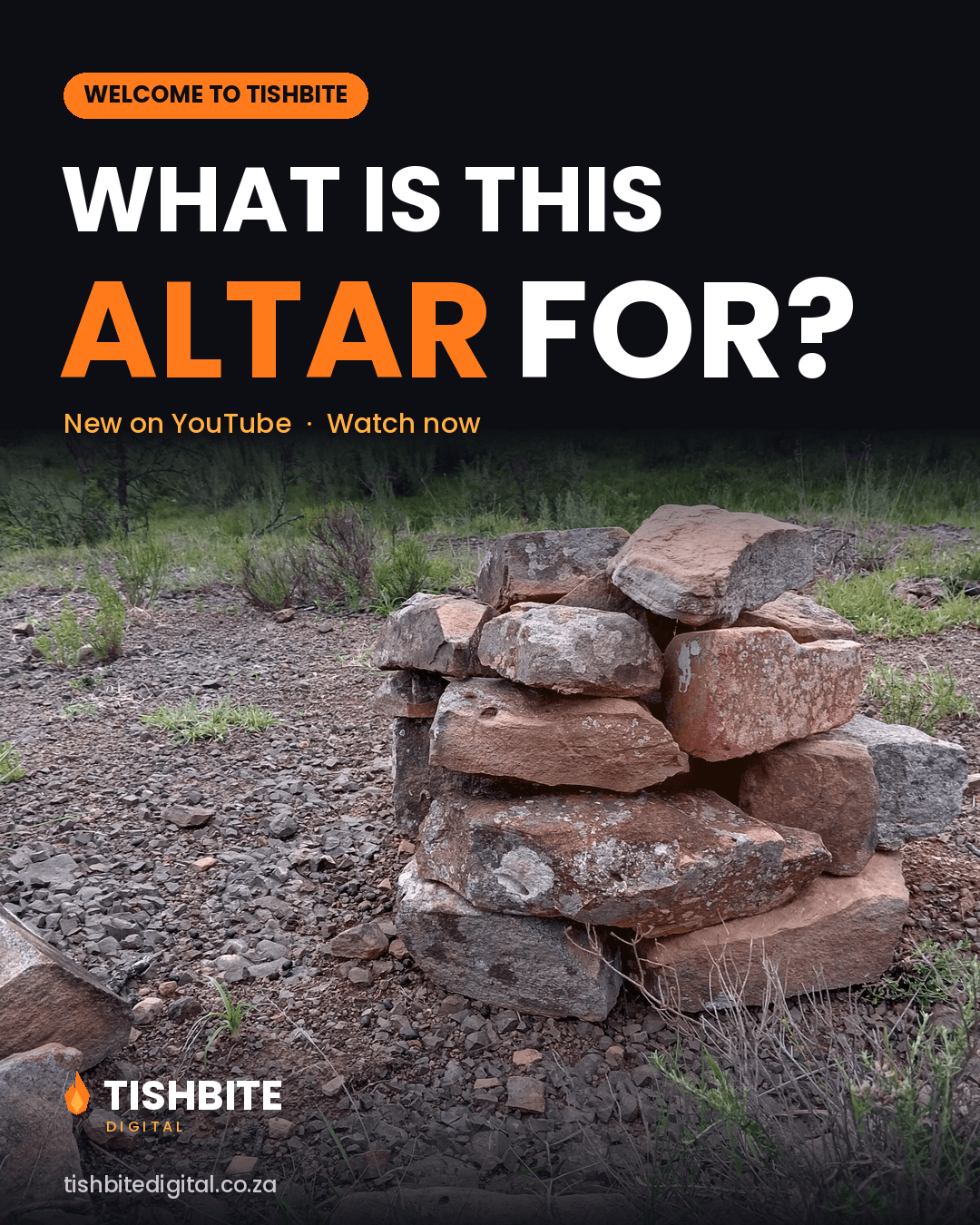
What is this altar for?
What Is This Altar For?
An ancient question for the digital age.
[Pause] Imagine standing beside a massive stone altar. What would you ask?
Not simply, How was it built? Not even, Who built it? The more important question is: "What is this altar for?"
That question comes from Joshua 22:10--34. It is also a question worth asking about the digital world we use every day.
1. Altars in the Bible and the ancient world
In the ancient Near East, an altar was generally a designated place where offerings were presented to a deity. Depending on the culture and context, offerings could include animals, grain, incense or other gifts. Altars were not all identical, and their purpose depended on the community and the ritual being performed.
The Bible records altars built by individuals and communities: Noah built one after the Flood (Genesis 8:20); Abraham built altars during his journeys (Genesis 12:7--8); and Israel received instructions for altar construction and worship (Exodus 20:24--26; 27:1--8). Later biblical accounts describe altars associated with both faithful worship and idolatry (1 Kings 12:26--33; 18:30--39).
Archaeology gives us material evidence to examine alongside these texts. Excavations have uncovered Iron Age four-horned stone altars at sites including Tel Dan, Megiddo and Beersheba, as well as earthen altars at Arad and Tel Motza. These discoveries show that altar forms and religious practices varied across the region. Researchers compare their shapes, locations, associated objects and dates with biblical descriptions---but an archaeological identification is not automatically proof of every detail in a biblical narrative.
For example, archaeologist Adam Zertal identified a cultic structure excavated on Mount Ebal as a possible match for the altar described in Joshua 8:30--35. The site's interpretation remains debated, even though many scholars accept that it had a cultic function. That distinction matters: evidence, interpretation and faith claims are related, but they are not the same thing.
See the Biblical Archaeology Society discussion, "Which Altar Was the Right One in Ancient Israelite Religion?", and its overview of the debated Mount Ebal identification in the reading list below.
2. What does the word altar mean?
The Hebrew Bible commonly uses מִזְבֵּחַ (mizbēaḥ), a word connected with the Hebrew root z-b-ḥ, associated with slaughtering or sacrifice. In broad terms, it refers to a place where offerings are presented. The Bible also uses the language of altars for different functions, including the altar of incense (Exodus 30:1--10).
The ancient Greek translation of the Hebrew Scriptures, known as the Septuagint, commonly uses θυσιαστήριον (thysiastērion), a term linked to offering sacrifice. The New Testament also uses this word for an altar.
Another Greek word is βωμός (bōmos), meaning a raised platform or altar. In Acts 17:23, Paul refers to an altar in Athens bearing the inscription "To an unknown god." Some biblical reference works note that Greek Jewish literature, including 1 Maccabees, can distinguish thysiastērion from bōmos in particular contexts. But it would be too simple to claim that the Greek translators always used one word for good altars and another for bad ones. Usage depends on the text, period and context.
That brings us to an important distinction: the name of an altar alone does not tell us whether it serves good or evil. Its purpose and fruit matter.
3. The altar that almost started a war
In Joshua 22, the tribes of Reuben, Gad and half the tribe of Manasseh built a large altar beside the Jordan River. The other Israelites feared that it was a rival place of worship and prepared to confront them.
The delegation, led by Phinehas, asked hard questions. The eastern tribes explained that the structure was not built for burnt offerings or sacrifices. It was meant to stand as a witness---to tell future generations that, despite the Jordan separating them geographically, they still belonged to the same people and worshipped the same God (Joshua 22:26--28).
The misunderstanding was resolved through investigation and conversation rather than war. The altar was named as a witness between them.
[Pause] Notice the lesson: an impressive structure is not enough. Before condemning it---or celebrating it---we must ask what it exists to do.
4. Our digital altars: what are we sacrificing?
Today, we may not gather around stone altars, but we gather around digital platforms. Websites, search engines, social networks, online marketplaces and recommendation algorithms influence what we see, desire, believe and buy.
A website is not literally a biblical altar. The comparison is a metaphor---but a useful one. Digital spaces are built around priorities. They can serve people, or they can treat people as resources to be extracted.
Ask of any digital platform:
- Does it manipulate? Does it use misleading headlines, fake urgency or hidden costs to push people into decisions?
- Does it sacrifice the vulnerable for profit? Does it exploit children, desperate customers, workers or people who do not understand how their data is being used?
- Does it humiliate? Does it reward bullying, public shaming and outrage because those behaviours generate clicks?
- Does it corrupt? Does it spread deception, conceal conflicts of interest or promote harmful products without regard for consequences?
- Does it serve? Does it help people find accurate information, make informed choices, connect with others and solve genuine problems?
Not every platform does all these things, and digital technology can also educate, connect, empower and create livelihoods. The point is not to condemn the internet. It is to examine the values built into the systems we create and support.
In digital marketing, success should mean more than traffic, impressions and conversions. How we get attention matters as much as whether we get it. Search engine optimisation (SEO) should help the right people find useful, truthful information. Web development should make services accessible, secure and clear. Social media marketing should build trust---not manufacture insecurity.
A digital space can generate profit while respecting human dignity. It can persuade without deceiving, measure performance without forgetting people, and grow a business without making the vulnerable pay the hidden price.
5. Tishbite Digital: building better digital spaces
At Tishbite Digital, we work at the meeting point of web development, search engine optimisation (SEO) and digital marketing. We help businesses strengthen their online presence so customers can discover them, understand what they offer and take the next step with confidence.
Our ambition is not simply to build more websites or chase higher rankings. It is to contribute to a healthier digital environment---one where useful information is easier to find, businesses communicate honestly, and technology serves people rather than exploiting them.
That commitment has practical implications: clear website content, accessible design, transparent marketing, responsible SEO, respect for users' privacy and calls to action that do not rely on deception. These are ideals to keep testing against our actual work, not just words to place on a website.
We cannot control every digital platform. But we can choose what we build, what we promote and what standards we accept.
So, whether you are a business owner, developer, marketer or everyday internet user, take a moment to examine the digital spaces you help create and sustain.
[Pause] Ask the ancient question again:
What is this altar for?
Is it built to serve people---or to consume their attention, dignity and trust?
The answer is revealed not only by what a platform says it stands for, but by what it rewards, what it protects and what it is willing to sacrifice.
Let us build digital spaces that bear witness to something better.
Further reading and sources
- Joshua 22:10--34 --- The altar by the Jordan. Read the biblical passage in context: https://www.biblegateway.com/passage/?search=Joshua%2022&version=KJV
- Biblical Archaeology Society --- "Which Altar Was the Right One in Ancient Israelite Religion?" An overview of four-horned and earthen altars and their archaeological contexts: https://www.biblicalarchaeology.org/daily/ancient-cultures/ancient-israel/which-altar-was-the-right-one-in-ancient-israelite-religion/
- Biblical Archaeology Society --- "A Biblical Altar on Mt. Ebal and Other Israelite Footprints in the Jordan Valley?" Background on the excavation and debate over identifying the Mount Ebal structure with Joshua's altar: https://www.biblicalarchaeology.org/daily/ancient-cultures/ancient-israel/biblical-altar-mt-ebal-israelite-footprints/
- Encyclopedia of the Bible, Bible Gateway --- "Altar." A reference overview of the Hebrew and Greek terminology: https://www.biblegateway.com/resources/encyclopedia-of-the-bible/Altar
- Elitzur, Yoel, and Doron Nir-Zevi. "A Rock-Hewn Altar Near Shiloh." Palestine Exploration Quarterly 135, no. 1 (2003): 30--36. https://doi.org/10.1179/peq.2003.135.1.30
Editorial note: Archaeological findings and interpretations are not all equally certain. This article distinguishes excavated evidence from debated identifications and uses the altar-to-digital-platform comparison as a modern ethical metaphor.